
A content strategy for nonprofits is the deliberate planning and management of all communication content, aligned to your organisation’s mission, audiences, and fundraising goals. Without one, you are publishing reactively, spending time on content that neither builds trust nor moves supporters to act.
The benefits go beyond tidier scheduling. A clear strategy means your messaging stays consistent across every channel, your team spends less time second-guessing what to post, and your donors receive a coherent picture of the impact their money creates. That coherence is what converts a one-time giver into a long-term supporter.
For UK nonprofits specifically, the stakes are high. Charities operate under Charity Commission expectations around transparency and public benefit reporting, which means your content carries a compliance dimension that commercial brands simply do not face. Getting your content right is not just good marketing; it is part of how you demonstrate accountability.

A well-built strategy also supports multiple goals at once. The same piece of content can raise awareness, demonstrate programme impact, and include a donation ask, without feeling cluttered or manipulative. That multi-functional approach is one of the clearest advantages a planned strategy gives you over ad hoc publishing.
Key benefits of a documented content strategy:
The most common mistake nonprofits make is choosing tools before goals. A new social media scheduling platform or a shiny CRM will not fix unclear messaging. Define what you are trying to achieve, who you are trying to reach, and what action you want them to take. Only then should you decide which tools support that work.
Vague goals produce vague content. “Raise awareness” tells your team nothing useful. Tie every content goal to a fundraising, volunteer recruitment, or advocacy outcome so that your team can see the point of each piece they create. This gives everyone a shared target. Tie every content goal to a fundraising, volunteer recruitment, or advocacy outcome so that your team can see the point of each piece they create.
Your donors, volunteers, corporate partners, and beneficiaries each need different content. A major donor wants evidence of impact and financial stewardship. A first-time small donor wants to feel emotionally connected to a cause. A corporate CSR manager wants data and reputational alignment. Segment your audiences and write distinct personas so your content speaks to each group rather than nobody in particular.

Sustained, manageable effort beats ambitious plans that collapse after six weeks. If your team can realistically produce one email newsletter and two social posts per week, build your content calendar around that. A modest, consistent output builds audience trust far more effectively than a burst of activity followed by silence.
A content calendar is not a luxury; it is the operational backbone of your strategy. Map out key dates: Charity Commission reporting periods, national awareness days relevant to your cause, peak giving seasons such as the Christmas period and Give as You Live campaigns, and your own fundraising deadlines. Tools like Google Sheets or Notion work perfectly well for smaller teams; you do not need specialist software to get started.
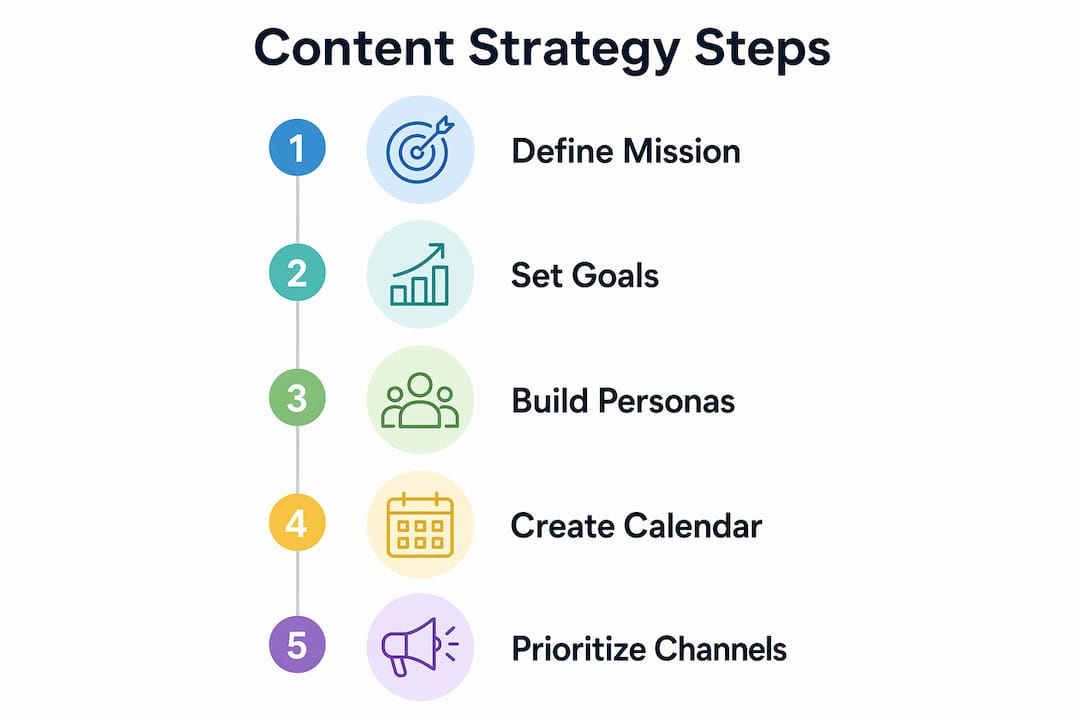
Organic social media reach for nonprofits is generally low; email marketing remains the top-performing owned channel for donor engagement and conversion. An email list you own cannot be taken away by an algorithm change. Invest in growing your list, segmenting it by donor type, and sending content that is genuinely useful rather than purely transactional. For practical guidance on building campaigns that convert, Viaductgen’s email marketing resources cover the mechanics in detail.
Before commissioning new content, review what you already have. Which blog posts still receive traffic? Which case studies are outdated? Which donation landing pages have weak calls to action? Refreshing existing content with current data, updated statistics, and tighter calls to action often delivers better search visibility than publishing brand-new posts.
Moving from campaign-only publishing to an always-on content approach means weaving programme updates, impact stories, and donation context into your content throughout the year, not just during appeal periods. Donors who hear from you only when you need money quickly learn to tune you out. Regular, mission-driven content keeps your cause present in their minds between campaigns.
Structuring your website content into pillar pages with connected cluster articles improves your authority in search engines and increases the likelihood of appearing in AI-generated answers. A pillar page on, say, “food poverty in the UK” supported by cluster posts on specific programmes, local statistics, and volunteer stories creates a web of relevant content that search engines and AI tools recognise as authoritative. Viaductgen’s guide to hub and spoke architecture explains how to build this model over 12 months.
Likes and follower counts are easy to track and largely meaningless for fundraising. Set up conversion tracking in Google Analytics 4 to measure how many people who read a blog post then clicked through to a donation page, or how many email recipients completed a volunteer sign-up. That data tells you which content actually moves people to act, which is the only metric that matters for a resource-constrained team.
UK nonprofits are increasingly held to account for how they represent beneficiaries in their communications. The Chartered Institute of Fundraising’s guidelines on ethical fundraising communications provide a clear framework: always seek informed consent, avoid imagery that exploits vulnerability, and present beneficiaries with dignity and agency. Ethical storytelling is not just the right thing to do; it builds the kind of long-term trust that sustains donor relationships.
Content is not free, even when it is produced in-house. Staff time, photography, video production, design, and copywriting all carry costs. Build a content budget that reflects the true cost of production, and prioritise formats that give you the most return. A well-produced impact video may cost more upfront but can be repurposed across email, social, and your website for months.
Pro Tip: When budgeting for content, calculate the cost per conversion rather than the cost per piece. A £500 video that generates £5,000 in donations is a better investment than ten £50 blog posts that generate nothing.
The formats that work best for nonprofits share one quality: they make the abstract concrete. Donors cannot see inside your programmes, so your content has to show them.
Impact stories are the single most powerful format. A specific story about one person, one community, or one measurable outcome creates an emotional connection that statistics alone cannot. The key is specificity: not “we helped many families” but a concrete, detailed example illustrating your impact.
Financial transparency content builds the donor confidence that sustains long-term giving. Annual reports, programme cost breakdowns, and “your £10 does this” explainers all help donors understand where their money goes. Framing contributions with specific financial impact metrics connects donations to measurable outcomes and reduces the vagueness that erodes trust.
The following content types consistently perform well across UK nonprofit audiences:
Pro Tip: Repurpose every major piece of content across at least three formats. An impact report becomes a blog post, a social media carousel, and an email newsletter section. You produce once and distribute many times, which stretches a small team’s output considerably.
The most effective nonprofit content does not separate “awareness content” from “fundraising content.” Content that simultaneously addresses problem awareness, proof of approach, and funding impact avoids donor confusion and builds clearer, stronger relationships over time.
Think of it as a single piece of content carrying three jobs: it shows the problem exists, it demonstrates your organisation’s credibility in addressing it, and it makes a specific, contextualised ask. A blog post about food poverty in a specific UK region, featuring programme data and a quote from a programme manager, followed by a “donate £15 to cover one family’s food parcel” button, does all three without feeling like a hard sell.
Building a supporter journey through content:
The channel mix matters too. Digital tools amplify a clear, human-centred mission rather than replacing it; your website and email list are the foundation, with social media serving as a discovery and traffic-driving layer rather than a primary engagement channel. Keeping supporters on owned channels means you control the relationship.
Donor psychology also plays a role in how you sequence content. Supporters who have received six months of consistent, mission-driven updates before a campaign ask are far more likely to give than those who only hear from you during appeals. Consistent email marketing keeps your cause top of mind between campaigns, which is why the always-on approach pays dividends at appeal time.
Avoid donor fatigue by varying the emotional register of your content. Not every piece should be urgent or emotionally heavy. Celebratory content, behind-the-scenes updates, and volunteer spotlights give supporters a reason to stay engaged without feeling constantly pressured.
Working across more than 50 client engagements, Viaductgen has identified a consistent pattern in nonprofit content that converts: the most effective pieces integrate awareness, impact evidence, and a donation request within a single, multi-functional narrative rather than separating these elements across different campaigns.
The practical implication is that your content calendar should not have “awareness weeks” and “fundraising weeks” as separate phases. Donors do not think in campaign cycles. They make giving decisions based on accumulated trust, and that trust is built through consistent, specific, evidence-based content published throughout the year.
“Digital is a great megaphone, which is excellent at broadcasting a message, but if your strategy is not clear at the outset, then you are just yelling as opposed to communicating.” Alva H. Taylor, Faculty Director, Glassmeyer/McNamee Center for Digital Strategies, Tuck School of Business at Dartmouth College.
Viaductgen’s approach to nonprofit content draws on Answer Engine Optimisation (AEO), which structures content for AI citations by organising information into topic clusters. As AI-powered search tools increasingly surface direct answers rather than lists of links, nonprofits that structure their content around clear questions and specific answers will gain a discoverability advantage over those publishing unstructured blog posts.
Viaductgen’s evidence-based best practices for UK nonprofits:
For nonprofits ready to connect their content output directly to fundraising outcomes, Viaductgen’s AI-powered approach to client work offers a framework that ties every content decision to measurable commercial results. The same methodology that drives revenue for mid-market businesses applies directly to donation conversion and supporter lifetime value for charities.
A mission-led content strategy, built on owned channels, ethical storytelling, and consistent publishing, is the most reliable path to sustained donor engagement and fundraising growth for UK nonprofits.
| Point | Details |
|---|---|
| Mission before tools | Define your goals and audiences before selecting any platform or technology. |
| Email outperforms social | Organic social reach is generally low; email remains the top-performing owned channel for donor conversion. |
| Always-on beats campaigns | Regular, year-round content builds the trust that makes appeal campaigns significantly more effective. |
| Multi-functional content | The strongest pieces address problem awareness, programme credibility, and a donation ask within a single narrative. |
| Measure conversion, not reach | Track donation completions and supporter retention rather than likes and follower counts. |

